Natural, Open-Ended Toys
…and the Power of Imaginative Play
In early childhood, the toys we bring into a child’s environment quietly shape the way they think, create, and explore the world. In Waldorf early childhood and many developmental approaches, we intentionally choose simple, natural, open-ended toys because they leave space for the child’s imagination to lead.
When a toy does less, the child does more.
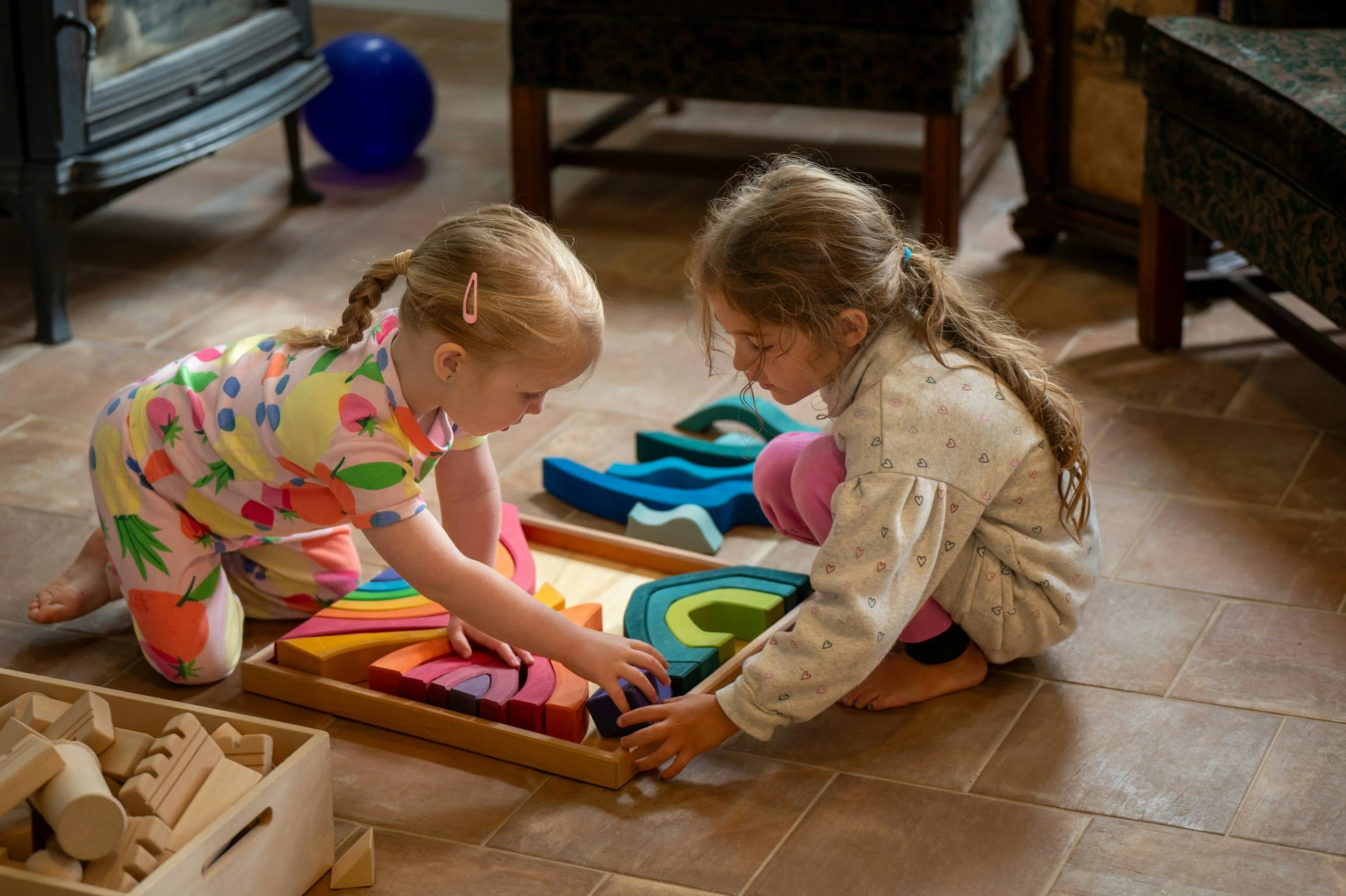
A silk cloth may become a superhero cape, a flowing river, a picnic blanket, or a cozy bed for a doll. A basket of wooden blocks might transform into a house, a boat, a farm, or an animal shelter. A few simple figures can spark entire story worlds that unfold over hours or days.
This kind of play is not random or trivial—it is deep developmental work.
Why Simplicity Matters in Toys
Modern toys often arrive fully designed with sounds, lights, buttons, and fixed storylines. While they may be entertaining, they leave little room for a child to invent or imagine.
Open-ended toys, by contrast, are intentionally simple. They invite the child to bring their own ideas into the play.
Research in early childhood development shows that imaginative play supports:
Creativity and flexible thinking
Language development
Emotional processing
Problem-solving skills
Social understanding
According to research on play and learning by developmental psychologist Peter Gray, children develop many of their most important cognitive and social abilities through self-directed imaginative play.
Imagination as Emotional Work
Children often use play to process experiences from their day or their inner emotional world.
A child may create a “family” with dolls, acting out care, conflict, or nurturing. Animals may build homes, go on journeys, or rescue one another. Through these stories, children rehearse relationships and explore feelings in a safe and symbolic way.
Play therapist Virginia Axline, a pioneer in child-centered play therapy, wrote in her book Play Therapy that play is a child’s natural language for expressing experiences they may not yet have words for.
When children have access to simple materials, they can shape the story themselves.
The Waldorf Approach to Toys
In Waldorf education, the environment is carefully prepared to encourage imagination. Toys are often made of natural materials such as wood, wool, silk, and cotton. These materials are warm, sensory-rich, and adaptable.
Educational philosopher Rudolf Steiner emphasized that young children learn through imitation, movement, and imaginative play, rather than through intellectual instruction.
A simple play environment might include:
Wooden blocks
Play silks or cloths
Handmade dolls
Baskets of pinecones, stones, or shells
Wooden animals or figures
These toys do not dictate the story. The child becomes the storyteller.
Creativity Grows in Open Space
When children encounter toys with many predetermined functions, the brain becomes more passive. The toy performs, and the child watches.
Open-ended toys reverse this dynamic. The child must imagine, design, and experiment.
Research on creative play summarized in The Importance of Being Little by Kim John Payne notes that simpler environments often lead to longer periods of sustained, focused play.
This type of play builds attention, perseverance, and confidence.
The Magic of “Loose Parts”
Architect Simon Nicholson developed the concept of Loose Parts Theory, which suggests that environments rich in moveable materials stimulate creativity and discovery.
Loose parts might include:
Wooden pieces
Fabric scraps
Natural objects like sticks or stones
Small baskets or bowls
Children arrange, combine, and rearrange these materials in endless ways, strengthening both imagination and problem-solving skills.
Supporting Imaginative Play at Home
Parents can support this type of play by simplifying the toy environment.
Consider:
Rotating toys so fewer are available at once
Offering open-ended materials like blocks and cloths
Creating cozy play spaces with baskets and natural light
Allowing uninterrupted play time without adult direction
The goal is not to entertain the child, but to create the conditions where imagination can flourish.
When Toys Do Less, Children Do More
The beauty of open-ended toys is that they grow with the child.
The same silk cloth that once wrapped a baby doll may later become a castle banner, a fairy wing, or the ocean in an elaborate story. A simple set of blocks can support years of building, imagining, and experimenting.
In a world filled with stimulation and noise, these quiet toys offer something deeply valuable:
space for the child’s inner world to emerge.
References & Resources
Peter Gray – Free to Learn
Virginia Axline – Play Therapy
Kim John Payne – The Importance of Being Little and Simplicity Parenting
Rudolf Steiner – Waldorf early childhood education lectures
Simon Nicholson – Loose Parts Theory (1971)